RING-TAILED LEMUR
Lemur catta
LENGTH

95-109 cm
PESO

2,2-3 kg max
WEIGHT

20 years
The ring-tailed lemur is a primate endemic to Madagascar and one of the most recognizable lemur species due to its long tail with black and white rings. It lives in the south and southwest of the island and stands out among lemurs for spending a significant amount of time on the ground, although it also climbs and moves through the trees.
General characteristics
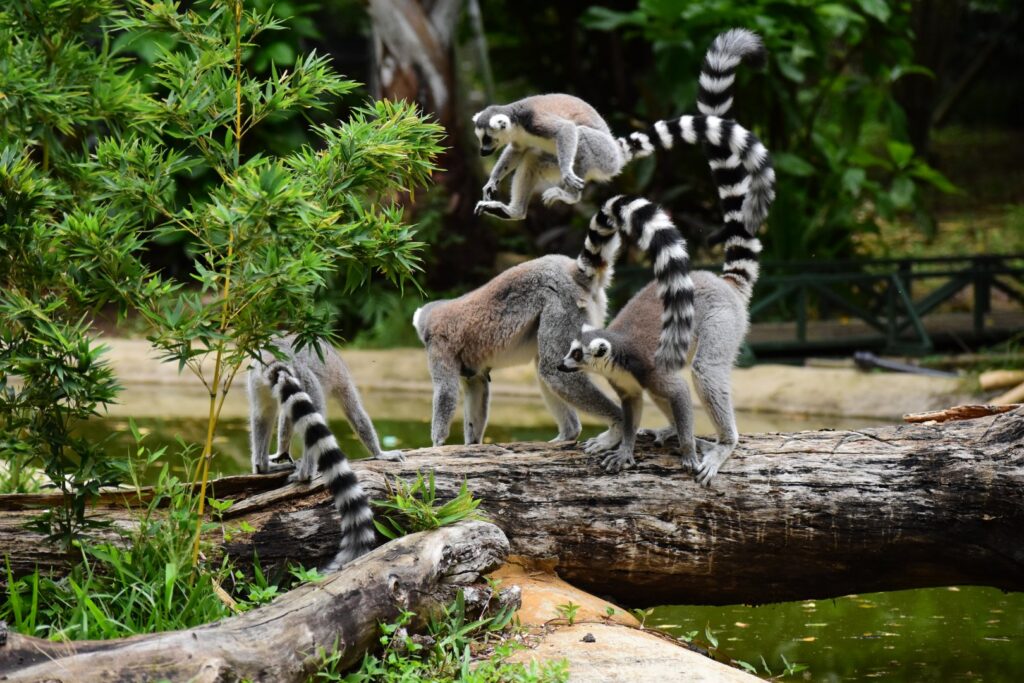
It is a medium-sized primate with gray and grayish-brown fur, a light-colored belly, and a white face. It has dark patches around the eyes, a black snout, and yellow to orange-colored eyes. Its most distinctive feature is its long, thick tail, which has 13 alternating black and white rings; this tail is not prehensile.
Its limbs are adapted for both walking on all fours and for climbing and jumping. Like other lemurs, it has a dental comb on the lower jaw and a specialized grooming claw on one of its toes, structures related to grooming.
Feeding
Its diet is omnivorous and opportunistic. It primarily feeds on red fruits, leaves, flowers, stems, and plant exudates, and may also eat insects and other small invertebrates, as well as small vertebrates on occasion.
In several parts of its range, tamarind fruits are an important food source. The exact composition of the diet varies depending on the season and food availability in each habitat.
Distribution
It is found exclusively in southern and southwestern Madagascar. Its distribution is patchy, with fragmented populations occurring across a broad region in the south of the island.
It inhabits riparian forests along rivers, dry scrublands, deciduous forests, and other open or semi-arid environments, as well as some moist montane forests. It is typically found in areas where wooded zones alternate with more open areas.

Behaviour
It is a primarily diurnal and highly social species. It lives in groups called troops, with complex social interactions and a distinct hierarchy in which females dominate males. Males tend to change groups more frequently, while females remain in their natal group.
It spends a considerable amount of time on the ground, more so than most other lemurs, and moves by walking or running on all fours. Communication combines body postures, vocalizations, and chemical signals; scent marking is particularly important, and in males it can be part of ritualized confrontations.
Reproduction
Reproduction is sexual and seasonal. Mating typically occurs between April and May, and after a gestation period of about 130 to 144 days, births usually take place between August and September.
Most often, a single offspring is born, although sometimes there are two. During the first few weeks, the young clings to the mother’s belly and later begins to move onto her back. Parental care falls primarily to the mother, although other females in the group may assist in watching over and grooming the young. Weaning is complete at approximately five months.
Did you know?
The ring-tailed lemur’s tail has 13 distinct black and white bands.
It is one of the most ground-dwelling lemurs and can spend a significant part of the day moving around on the ground.
When the group moves, it usually holds its tail upright, which helps create a sense of visual unity among its members.
Threats
The main threats in the wild include habitat loss and fragmentation, logging, fires associated with agricultural expansion, charcoal production, and other forms of forest degradation. Fragmentation isolates populations and jeopardizes their long-term viability.
Added to these pressures are hunting for food and illegal capture for the pet trade. Furthermore, climate change and droughts can exacerbate habitat loss and resource scarcity in parts of its range.
Conservation status